Videos
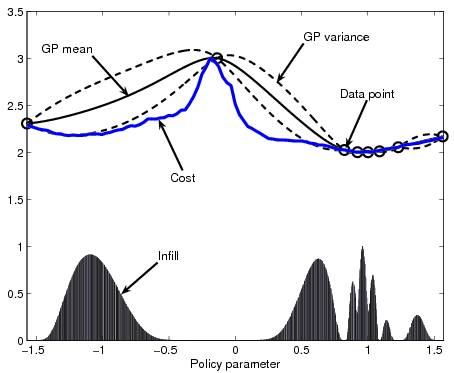
| A Bayesian exploration-exploitation for robot navigation under uncertainty |
| Improving EKF-SLAM Consistency: The Robocentric Map Joining |
| Homography based Visual Navigation |
Projects
On-going
Past projects
Funding:
(sp) Spanish Government, (pt) Portuguese Government, (eu) European Commission
Brief Research Statement
My scientific interest focuses on developing new algorithms and models to learn and understand the world that we live in. Using that knowledge, I want to create autonomous systems that can interact and “live” with us. My research aims to improve reasoning methods, but also, to discover the mathematical, physical and computational models that rule our decisions and, finally, to understand our cognition. To this point, my contribution can be summarize in this topics:
Robotics: Robots are the best autonomous agents to play with it. Their main advantage is being physical agents; therefore, being able to interact with the world that surrounds them. I have conducted research in simultaneous localization andmapping (SLAM), planning under uncertainty, sensor data modeling, visual control and developmental learning.
Active Learning: Once you have an agent that can interact with the environment, the next step is to use that advantage to improve the learning capabilities of the agent/robot. In that sense I see active learning as a general framework that includes the classical concept of active supervised learning, sequential experimental design and reinforcement learning with intrinsic rewards.
Bayesian Inference: While doing active learning, it is very useful to have a prior distribution over what you expect to get. Also, the agent should be able to update it sequentially as new data arrive. While working on SLAM, I found one of the hardest problems in Bayesian inference for continuous signals. In fact, SLAM has attracted the attention of the machine learning and signal processing communities. It resembles the problems of adaptive filtering, adaptive control and system identification; where both states (dynamic variables) and parameters (static variables) of a certain physical model need to be jointly estimated.
Perception: In the past, I have developed geometric and probabilistic based algorithms for image understanding, visual control and tracking. Currently, I use computer vision as a cheap, powerful and intuitive sensor for robots. I have also studied clustering methods for lidar data.